If you have a stress test coming up, it’s natural to feel a little nervous or unsure about what’s ahead. But this simple, noninvasive test gives you and your doctor valuable information about how your heart is working.
Suzanne Sorof, MD, a cardiologist with HonorHealth Heart Care, says a stress test can give you answers and reassurance about your heart health, whether you’ve noticed shortness of breath, are preparing for surgery or just want peace of mind.

What is a stress test?
A cardiac stress test shows how your heart performs when it’s working hard. Your doctor may recommend one that increases your heart rate through exercise or a special medication for several reasons:
- You may be experiencing shortness of breath or unusual pressure in your chest.
- You may have had an abnormal result from another test.
- You may have had a heart attack, and your doctor wants to make sure you're strong enough to participate in a cardiac rehabilitation program.
- Your doctor may want to ensure that you're strong enough to engage in a sport or intense exercise or tolerate a major surgery.
"If you have a blockage in your heart, shortness of breath or chest pain with any exertion may be present," says Dr. Sorof "A stress test helps us determine whether your symptoms are being caused by a blocked artery."
A stress test can help:
- Detect a 70% or greater narrowing of an artery
- Show if your fitness is higher or lower than average
- Measure your blood pressure response to exercise
- Track how quickly your heart recovers after exertion
Types of cardiac stress tests
The type of test you have depends on your fitness level and any medical limitations.
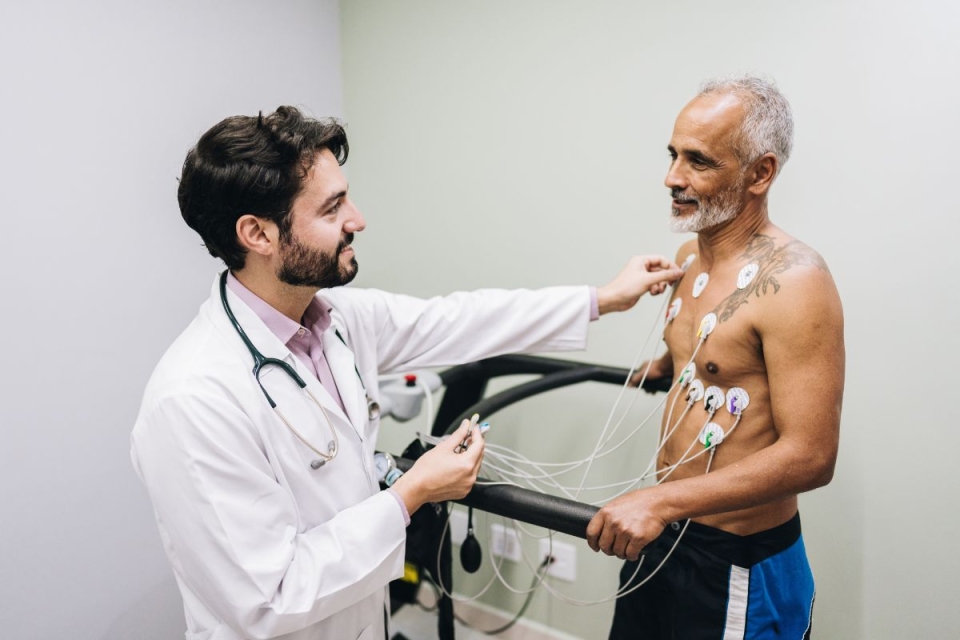
- Exercise stress test: You walk on a treadmill while the speed and incline gradually increase to raise your heart rate.
- Exercise echo stress test: If you are able to exercise but have minor EKG abnormalities, this test may be recommended. Ultrasound images are taken before and after exercise to show how your heart muscle responds, helping your doctor spot any areas where blood flow may be reduced.
- Nuclear stress test: If a standard stress test doesn’t explain your symptoms, your doctor may order this version. A safe radiotracer medication is injected into your vein, and a special camera tracks how it flows through your heart. "After that, most people will walk on a treadmill until their heart rate speeds up and repeat the process of following the radiotracer through the heart," Dr. Ray says.
- Chemical stress test: If you are unable to exercise, a medication such as regadenoson or adenosine is used to mimic the effects of exercise by widening your arteries. Another option, dobutamine, makes your heart beat faster and harder for the same effect.
How to prepare
Dress comfortably in closed-toe gym shoes and socks. Wear clothing that is easy to remove, since electrodes will be placed on your chest and legs to measure your heart rate. You will wear a hospital gown during the test, and women are encouraged to wear a sports bra for extra support.
Understanding your results
A normal stress test result means your doctor believes there is a low chance of an artery blockage. About half of all stress tests fall into this category.
If your results are abnormal, your doctor will review them closely to determine what is causing the changes. If you already have a known blockage, a stress test helps show whether it is getting worse.
“If we see borderline changes, we may want to repeat the test with images before and after exercise to get a clearer picture,” Sorof says.
What happens next
Once your results are reviewed, your doctor will discuss next steps with you. You may need:
- Medication to help lower blood pressure or heart rate during exercise
- Cholesterol-lowering medication
- A daily low-dose aspirin
- Medication to reduce chest pain (angina) or chest pressure
If medication is not enough, you may be advised to have a coronary angiogram to see if your blockage can be treated.
No matter your results, your HonorHealth care team is here to explain what they mean and help you take control of your heart health.